Rethinking Health Apps & Tracking with Embedded intelligence — P1
“An interface is humane if it is responsive to human needs and considerate of human frailties”
This post is also on my Linkedin account - dated 17th May, 2026 : LINK
The Burden of Feature Bloat in Health Apps
For years, apps like Apple Health and Google Health have served as central repositories for our wellness data. Powerful and genuinely useful — but their vastness comes at a cost: complexity and cognitive overload.
My father is a physician with forty years of experience. He is no stranger to complex software. Yet he finds mobile health apps consistently frustrating — confusing information hierarchies, feature creep, controls that are hard to find and harder to modify. Whether setting up a blood pressure tracker or logging medication intake, simple tasks feel buried, and the interface offers little room to adapt. He is not alone in this, there’s a bunch of views out there linklinklink
Facing the same frustrations as an everyday user, I decided to catalogue the problems and start acting on them. Over the past several weekends I have been building fully-fledged iOS & Android app prototypes to live with (using AI prototyping tools of course)— exploring how AI-enabled interfaces can reduce this cognitive burden and make health tracking genuinely easier to use.
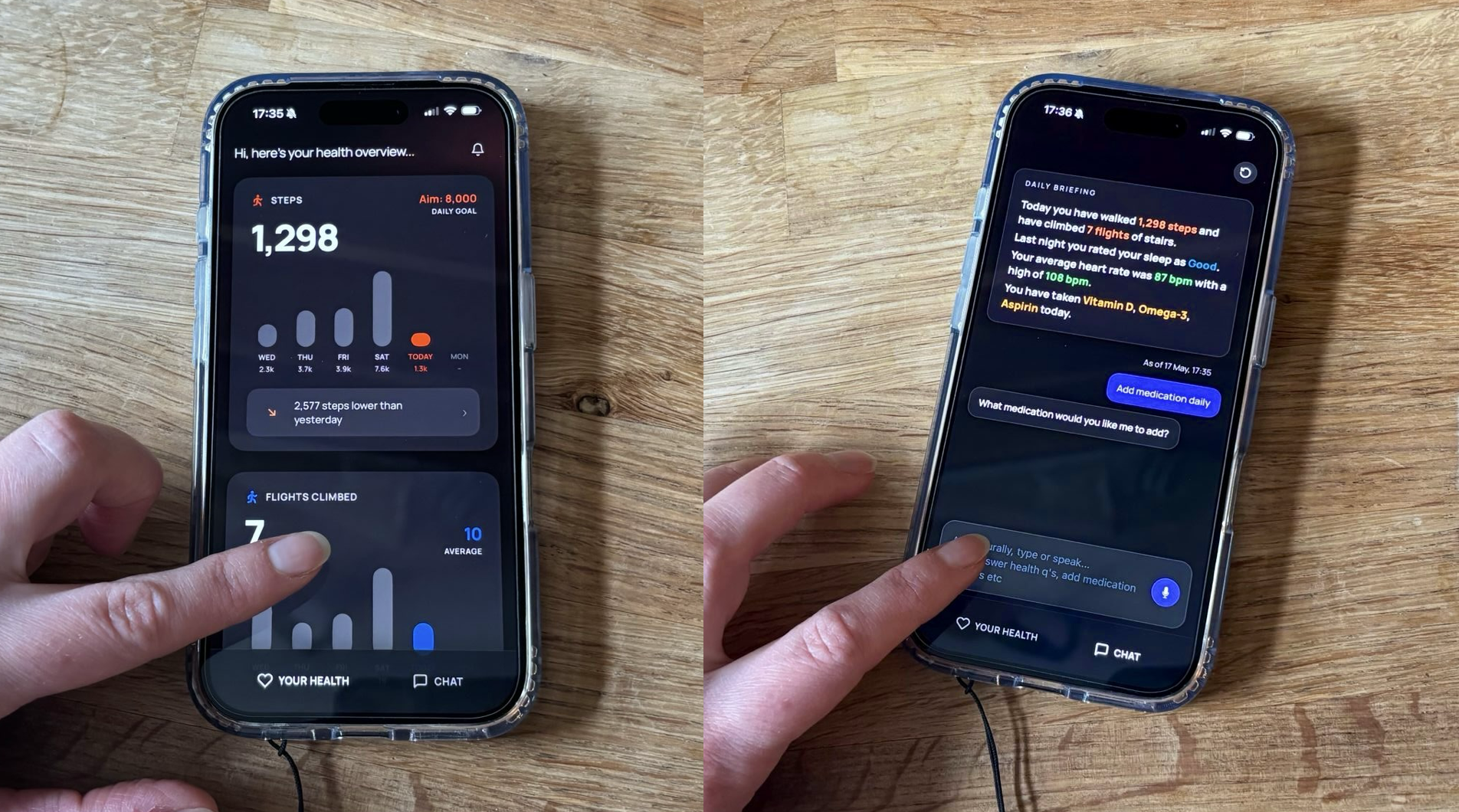
The current prototype I am living with…
Why: The Human Problems Worth Solving
What follows is informal research — drawn from reading, personal experience, and conversations with both serious and casual trackers. Essentially: what my father and I would actually want from a health app.
Speed of interaction and IA complexity. "Where do I find my heart rate trends? How do I add a new medication?" Every new feature adds architectural complexity. Simple tasks get buried. Discoverability suffers.
Inability to see data relationships. "What's the relationship between my steps and my sleep?" Charting data over time exists, but drawing meaningful correlations across different parameters remains largely absent.
Lack of customisability. "I want to track my fibre intake by taking photos of food — can I just add that?" Everyone's circumstances are different. Health apps should reflect that.
Lack of contextual empathy and proactivity. "What I need to see changes constantly — can the app react to me?" What a person needs to track shifts by the day, through the day, and with how they are feeling. Most apps are reactive at best.
Notification and reminder setup. "Apple Health has great reminders, but setting them up takes real effort." Reminders should be configurable on the fly, without requiring deep knowledge of the interface.
Quick advice and support. "I already use ChatGPT for health questions — can that just live inside my health app?" Conversational AI is the obvious next step here, though it opens genuine questions around trustworthiness and sourcing — something I am still working through.
Two I am not tackling yet: connecting to personal health records, and enabling communication with doctors or care providers. Both require careful thinking about privacy, data permissions, and integration with health services — not something to prototype casually.
Diving Deeper: HealthMate and the AI-Embedded Approach
This gave me enough to work with. The result is a prototypical iOS/Android app I am calling HealthMate — arrived at through multiple iterations using Claude Code, Cursor, and Stitch. This is essentially a wrapper around Apple health or Google health, with the focus not on visual polish. It is behavioural UX: building something to live with, observe, and learn from over time.
The core problem is that current health apps offer a static, one-size-fits-all interface — over-reliant on feature density and fixed information architecture. The alternative I am testing combines three things: conversational UI, generative UI, and contextual awareness — used to augment an existing dashboard rather than replace it entirely. A helpful companion to reason with, alongside a structure that can flex to match what a person actually needs in a given moment.
This is not a cosmetic improvement. A static dashboard assumes the designer knows what you need. A generative, contextually aware one stays pliable — responding to both manual input and automatic inference about what matters right now.
Part One: What I am living with and logging everyday
Pillar 1 — Conversational Companion
A persistent conversational layer sits alongside the existing dashboard, enabling:
Natural language enabling faster access to actions that previously required navigating multiple UI layers — for example, adjusting a daily steps goal based on recent behaviour.
On-the-fly data interrogation — asking for a heart rate map across the day, without digging through charts.
Quick logging without UI interaction — voice input via Siri to mark medication as taken, a capability that did not exist before / harder to set up.
Open-ended health queries — eg. asking what to do about a neck ache, getting a considered response in context, whereas asking about a headache gets a different response.
Pillar 2 — Generative UI via the Conversational Companion
The conversational layer does not just answer questions — it reshapes the interface in response to them:
Explore relationships: Natural language prompts generate on-the-fly visualisations — for example, overlaying steps and heart rate data to reveal patterns
Focus mode: Ask to focus on steps, heart rate, and sleep — and everything else collapses away
New trackers on demand: Introducing a new goal — migraine tracking, water intake — dynamically generates the relevant input fields and widgets, without navigating settings
Reminders on the fly: Set or modify notifications through conversation, without needing to understand the notification settings hierarchy
A couple of asides
Letting Go of Rule-Based Design
One of the more interesting challenges of working this way is the need to let go of rule-based design — the instinct to define precisely how an interface can and cannot be used. Working with generative and conversational UI means setting guidelines and heuristics that both the AI and the user can operate within fluidly, rather than enforcing rigid interaction patterns. It is a different kind of design rigour, not an absence of it.
Hallucinations and bug fixing
Another battle has been with bug fixing and dealing with hallucinatory replies. I have tried to keep away from this rabbit hole and fix what I can given that this is a prototype, but have been fixing things on the fly which result in better quality interactions.
Part 2 — Coming Up in the Next Iteration
Contextual empathy: when the UI gets out of the way of behaviour
The next stage — once I have lived with the current prototype long enough to draw conclusions — is to move toward fully context-driven UI generation. Rather than a dashboard of twenty metrics, the AI assesses the current situation and surfaces only what matters most right now. This is not far away, there are services and apps offering capabilities that are close, resembling coaches: Onva, Bevel
The same underlying data, but possibly radically different interfaces — because the need is different.
But this surfaces the harder design problem. If your heart rate is elevated and you have not logged lunch and you are behind on steps — what gets surfaced? The prioritisation logic that answers that question — balancing urgency, goal proximity, anomaly severity, and user history — is where the real design work lives.
The End Goal: Simplicity, with the Human Always in the Loop
This brings me to questions I keep returning to: How much of this prioritisation should the AI own, and how much should remain in the user's control? How much will a person trust, when an AI companion provides a recommendation? How do we build a fruitful relationship?
An AI that helps you interrogate patterns and understand your health better makes clear sense. But one that silently decides what you need — however accurately — risks creating a new kind of opacity: users losing legibility over their own health picture. The goal is not to replace your judgment or overtake cognitive abilities. It is to reduce the effort required to exercise it, by using AI to understand patterns, build memory trails & a legible health history.
I hope to understand this better over the next few months of living with the prototype.